
How to Use Tokens on Binance Exchange: A Beginner’s Guide to Trading & Utility

Binance, one of the world’s largest cryptocurrency exchanges, operates on a dual-token ecosystem: its native BNB token and a vast array of other digital assets known as “tokens.” Understanding how to use these tokens within the Binance platform is essential for both new and experienced traders. This guide breaks down the practical steps, from acquiring tokens to leveraging their utility.
1. Acquiring Tokens on Binance
To start using a token, you first need to acquire it. On Binance, you can purchase tokens directly with fiat currency (e.g., USD, EUR) via the “Buy Crypto” feature, which supports credit/debit cards, bank transfers, and P2P trading. Alternatively, you can deposit existing tokens from another wallet or trade on the spot market. Simply navigate to “Markets,” search for the token pair (e.g., ETH/USDT), and place a market or limit order.
2. Transferring Tokens Within the Exchange
Once you own tokens, you can move them between different Binance services. Use the “Wallet” section to transfer tokens from your Funding Wallet (for deposits and withdrawals) to your Spot Wallet (for trading) or Margin Wallet (for leveraged trading). If you plan to stake or earn interest, move tokens to the “Earn” wallet. Each transfer is instant and free within the exchange, but withdrawals to external wallets incur network fees.
3. Trading Tokens on the Spot Market
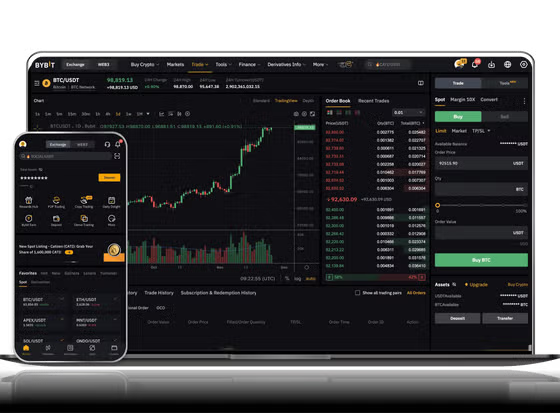
The most common use case is spot trading. On the Binance trading interface, select a token pair (e.g., BNB/USDT). The chart shows price history; you can place a “Market Order” to buy/sell at the current price, or a “Limit Order” to set a specific price. Advanced traders can use stop-limit orders, OCO (One-Cancels-Other) orders, or the “Trailing Stop” feature to automate trading strategies.
4. Utilizing Tokens for Utility and Discounts
Binance’s native token, BNB, offers unique utilities. Hold BNB in your account to pay trading fees at a 25% discount (automatically applied). BNB is also used for Binance Launchpad participation, where you can stake BNB to receive allocations of new token projects. Additionally, you can use BNB to pay for withdrawal fees, transaction fees on Binance Chain, and even travel bookings through Binance’s partnerships.
5. Staking and Earning with Tokens
Many tokens on Binance can earn passive income. Go to “Earn” > “Simple Earn” to stake tokens like ETH, DOT, or ADA. You receive daily interest based on the annual percentage yield (APY). For higher returns, try “Defi Staking” or “Locked Staking” for a fixed period. Binance also supports “Launchpool,” where you stake BNB to farm new tokens. Always check the unstaking period and risks before locking tokens.
6. Withdrawing Tokens to External Wallets
To use tokens outside Binance (e.g., on a hardware wallet or DeFi protocol), withdraw them via “Wallet” > “Withdraw.” Select the token, enter the recipient address, and choose the correct network (ERC-20, BEP-20, etc.). Mismatching networks can result in permanent loss. Binance imposes a minimum withdrawal amount and a small network fee (often reduced if you pay with BNB).
7. Security and Best Practices
Always enable two-factor authentication (2FA) and whitelist withdrawal addresses. Use the “Earn” feature judiciously—staked tokens may have liquidity lock-up periods. When trading, use the “Demo Trading” feature to practice first. Remember that token prices are volatile; never invest more than you can afford to lose. For high-value tokens, consider using a cold wallet for long-term storage.
In summary, using tokens on Binance involves a straightforward workflow: acquire, trade, utilize utility, stake, and withdraw. The exchange’s intuitive interface and comprehensive feature set make it accessible, but always educate yourself on the specific token’s rules and network requirements. Start with small amounts to test the process, and gradually explore advanced features like margin trading or futures once you’re comfortable.


发表评论